
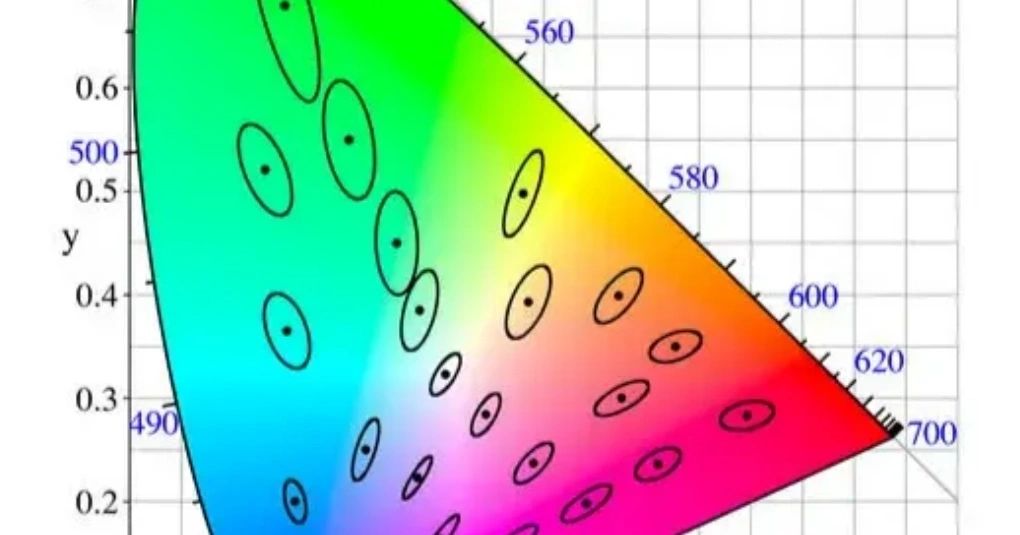
Just-noticeable color difference (JNCD) is of great importance to display calibration and specification, which is originally derived based on MacAdam Ellipses. The most widely used specification of 1 JNCD is 0.004 (or 0.0033) unit of u'v' or 2.3 unit in CIELAB.
However, two critical issues have been overlooked in past studies:
First, the color or chromaticity differences calculated using different CMFs have different magnitudes. As shown in our previous study, when comparing the performance of different CMFs, the calculated chromaticity differences cannot be directly compared without proper scaling.
Second, the JNCD value derived using 2° stimuli is widely assumed to be applicable to stimuli with other sizes, which has never been systematically investigated.
Our study aimed to answer three questions:
1. What is the definition of JNCD?
CIE TN 001 states "... its concept is not clearly defined or universally agreed in any standards or available scientific literature" and "...MacAdam implied that JNCD is about three times the standard deviation..." For analyzing data collected in psychophysical experiments, four methods are commonly used: one standard deviation, three standard deviations, 95% confidence interval, and 50% probability. Thus, we want to clearly define JNCD.
2. Specification of JNCD using different CMFs
The specification of 0.004 u'v' is used in practice no matter which CMFs are used. Also, such a specification is widely used to compare the performance of different CMFs. However, the change of CMFs will change the scale of chromaticity diagram. Thus, we want to investigate whether CMFs will affect the specification of JNCD when stimuli are carefully calibrated using each CMF.
3. Specification of JNCD for stimulus with an FOV different from 2 degree
The stimuli used in MacAdam's experiment were 2°, but the specification of JNCD is widely used for stimuli with different FOVs. In practice, we need to specify JNCD for larger stimuli (e.g., 10°). Thus, we want to investigate whether 2° and 10° stimuli should have different specifications of JNCD.
The Scale Issue of Different CMFs
To illustrate that the four CMFs indeed have different scales, we calculated the chromaticity differences Δu'v' between two blackbody radiators with a CCT difference of 100K using the four standard CMFs and scaled to those calculated using the CIE 1931 2° CMFs.
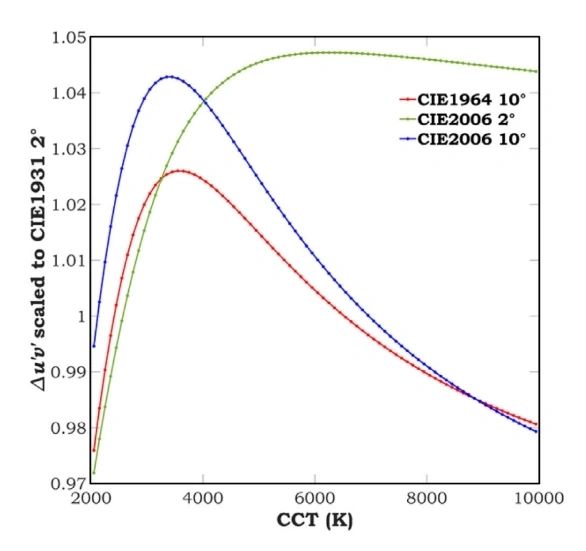
It can be observed that the four CMFs indeed have different scales, which also depend on the chromaticities. This suggests that when we calibrate stimuli using different CMFs, the specification of JNCD may need to be reconsidered.
Experiment
Nine observers (five males and four females) between 25 and 29 years of age completed the experiment. All observers had normal color vision, as tested using the Ishihara Color Vision Test.
The observers were asked to judge whether there is a color difference between a pair of stimuli, both of which were produced by an EIZO display (this helped to avoid the effect of spectrum). We included five colors (i.e., white, red, yellow, green, and blue), and two sizes (i.e., 2° and 10°). One of the two stimuli in each pair was a reference stimulus, whose chromaticities were fixed, while the other was a test stimulus.
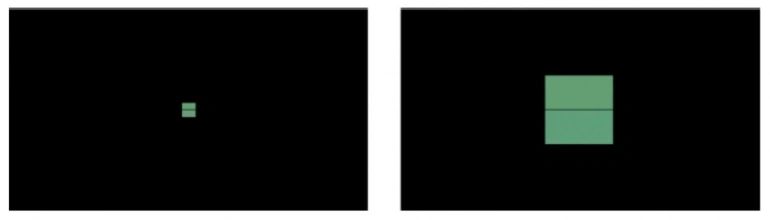
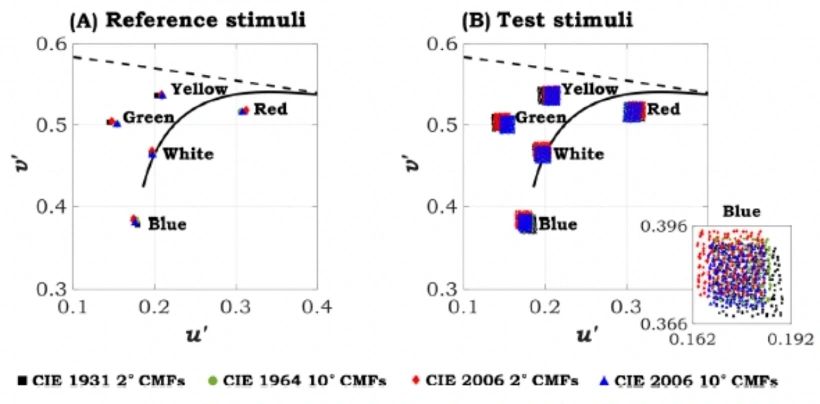
The chromaticities of the test stimuli were carefully calibrated using four standard CIE CMFs (i.e., CIE 1931 2°, CIE 1964 10°, CIE 2006 2°, and CIE 2006 10° CMFs) to uniformly distributed around the chromaticities of the reference stimulus in u'v' diagram, with a grid of 14 × 14 and a spacing of 0.0015 u'v' unit.
Each observer made 2010 judgments (i.e., 201 pairs × 5 color centers × 2 FOVs), which took around 1 hour. Five of the 196 pairs were presented twice to evaluate intra-observer variations.
Results and Discussions
Intra- and inter-observer variations
The intra-observer variations were characterized based on the repeated judgments. Among 450 repeated judgments, 380 judgments were the same (84.4%). The inter-observer variations showed that 82.49% to 96.52% of the judgments, with a mean of 92.80%, were consistent among observers.
Derivation of JNCD ellipses
We followed the method in MacAdam and Wyszecki to fit the standard deviation ellipses and the 95% confidence ellipses, with the chromaticities of the test stimuli that were judged to have no color difference used as the input.
With Gaussian distribution:
- One standard deviation ellipse = 39.35% confidence level
- Three standard deviation ellipse = 98.89% confidence level
- 95% confidence ellipse = 2.45 standard deviations
- 50% probability ellipse = 1.18 standard deviations
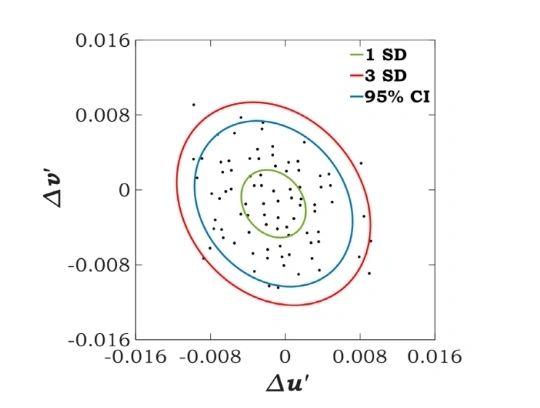
After the observers made the judgments, we analyzed the data and derived the JNCD ellipses using the four methods, which indeed produced different sizes of the ellipses.
Effect of CMFs, FOVs, and color centers
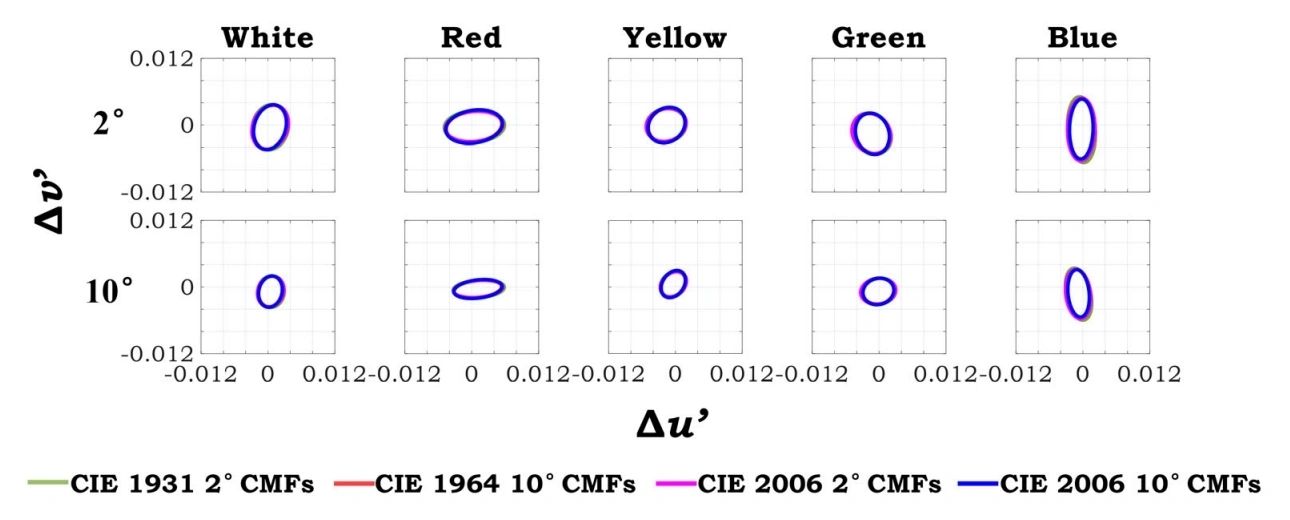
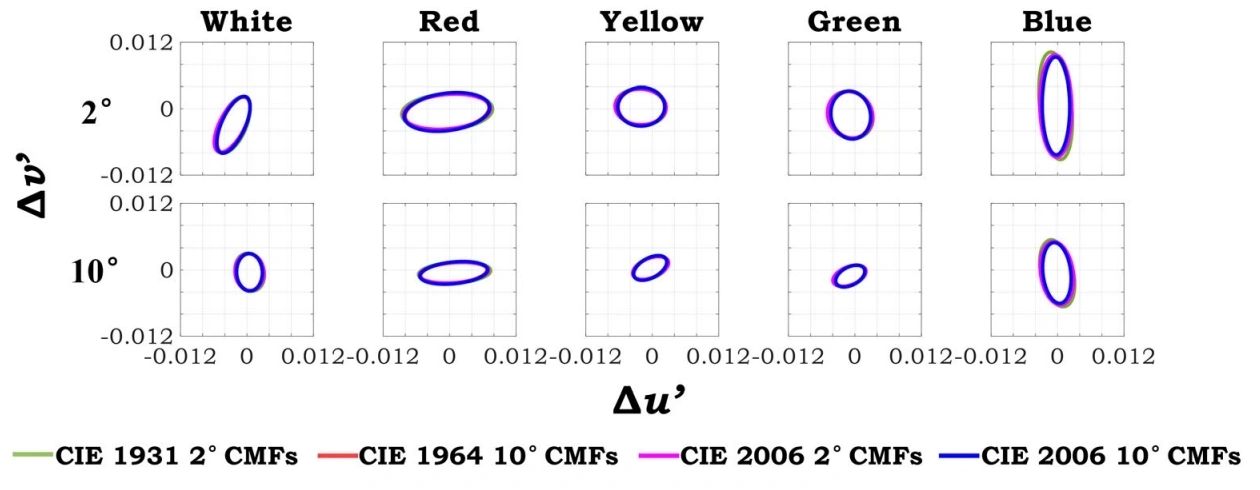
It can be seen that the ellipses derived using the different CMFs had very similar shapes and sizes for each color center and FOV. This is because we carefully calibrated the stimuli using each CMF, rather than simply calculating the same stimuli with different CMFs.
Importantly, the ellipses for the 2° FOV were consistently greater, with a scale around 1.4, than those for the 10° FOV, suggesting that the observers were more sensitive to the chromaticity differences when viewing 10° stimuli.
The ellipses for the five color centers had some differences.